Top Signs You Need Garage Door Service – Don’t Ignore These
The signs you need garage door repair are a door that grinds, screeches or pops when it moves, one that drifts back open a few inches after closing, a door that lifts unevenly at one corner, and any door where you can see a frayed cable, flat-spotted roller or a gap under the bottom seal. Most Sun City Center homeowners notice one of these and wait months before calling, which is exactly how a small, cheap fix turns into a spring, cable and opener repair all at once.
If reading through this list makes you realize your door has been “doing that for a while,” call us at (855) 658-4128. Estimates are free, and we’ll tell you plainly whether it’s a worn roller or a spring on its last legs.
What does a failing garage door sound like?
A door that needs lubrication makes a steady, dry squeak or a light metal-on-metal rasp that fades as the door travels. A door headed for a spring failure makes a sharp popping, snapping or booming sound, usually at the moment the door starts to lift or close, and it gets louder and more frequent. That second profile is the one that shouldn’t wait.
Once you start listening, most doors tell you clearly which category they’re in. The sounds break down like this:
- Dry squeal along the track: usually roller bearings or a hinge pin running without grease. Often the cheapest fix on this list.
- Grinding or rumbling that rattles the wall: worn roller wheels or a torsion tube that’s shifting in its bearings.
- A single loud bang from above the door, followed by the door feeling very heavy: this is the sound of a spring breaking. Stop using the door and call for garage door spring repair.
- Whining or buzzing from the opener motor: the motor is straining because something else is dragging, or the opener itself is failing. That’s an opener question, not a door question.
Here’s the part most people don’t expect: a spring rarely fails alone. When tension drops, the opener works harder, the cables take on more load, and the rollers and hinges wear faster. That’s how one ignored noise becomes three repairs.
Which visual checks catch a problem in under two minutes?
Four quick visual checks catch most developing problems before they become emergencies: look at the cables, the rollers, the bottom seal and the door’s alignment. Do them from the safety of the floor, with the door closed, and don’t reach into the mechanism or touch the springs or cables – those are under heavy tension and can cause serious injury.
- Cables. Follow the two steel cables down each side of the door. They should look tight and clean. Fraying strands, a kink, or a cable that’s slack on one side predicts a cable failure and should be inspected before the door runs again.
- Rollers. Look at the wheels inside the track. A healthy roller is round and turns freely. One with a flat spot, a crack in the wheel or visible wobble is dragging the whole door.
- Bottom seal. With the door closed, check for daylight or a gap under the rubber. A worn seal lets in rain, bugs and heat, and it’s one of the least expensive fixes you can make.
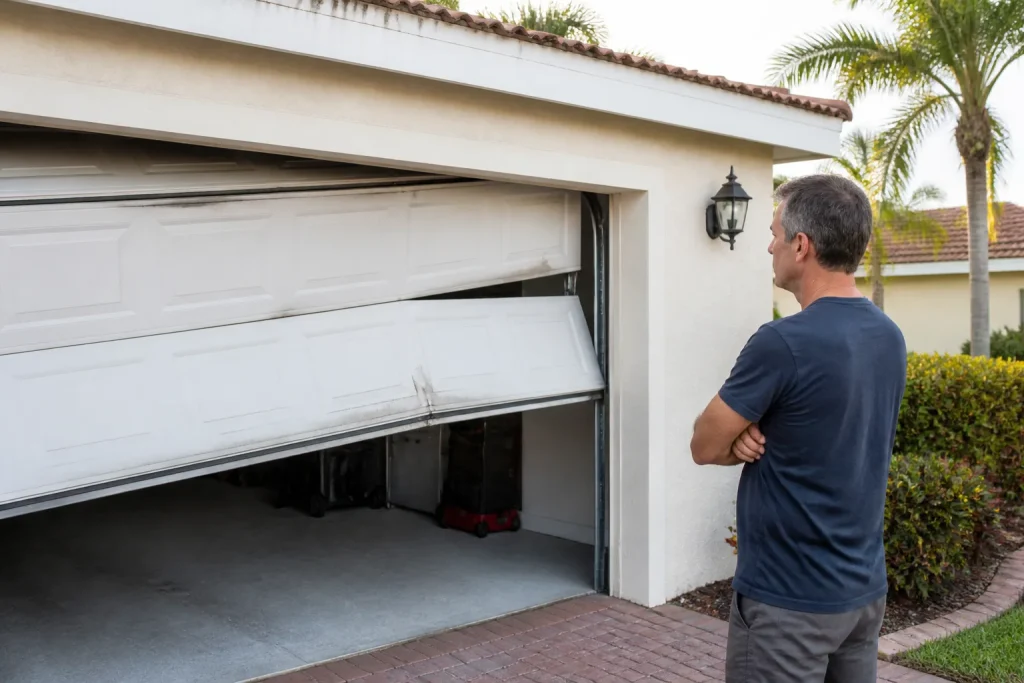
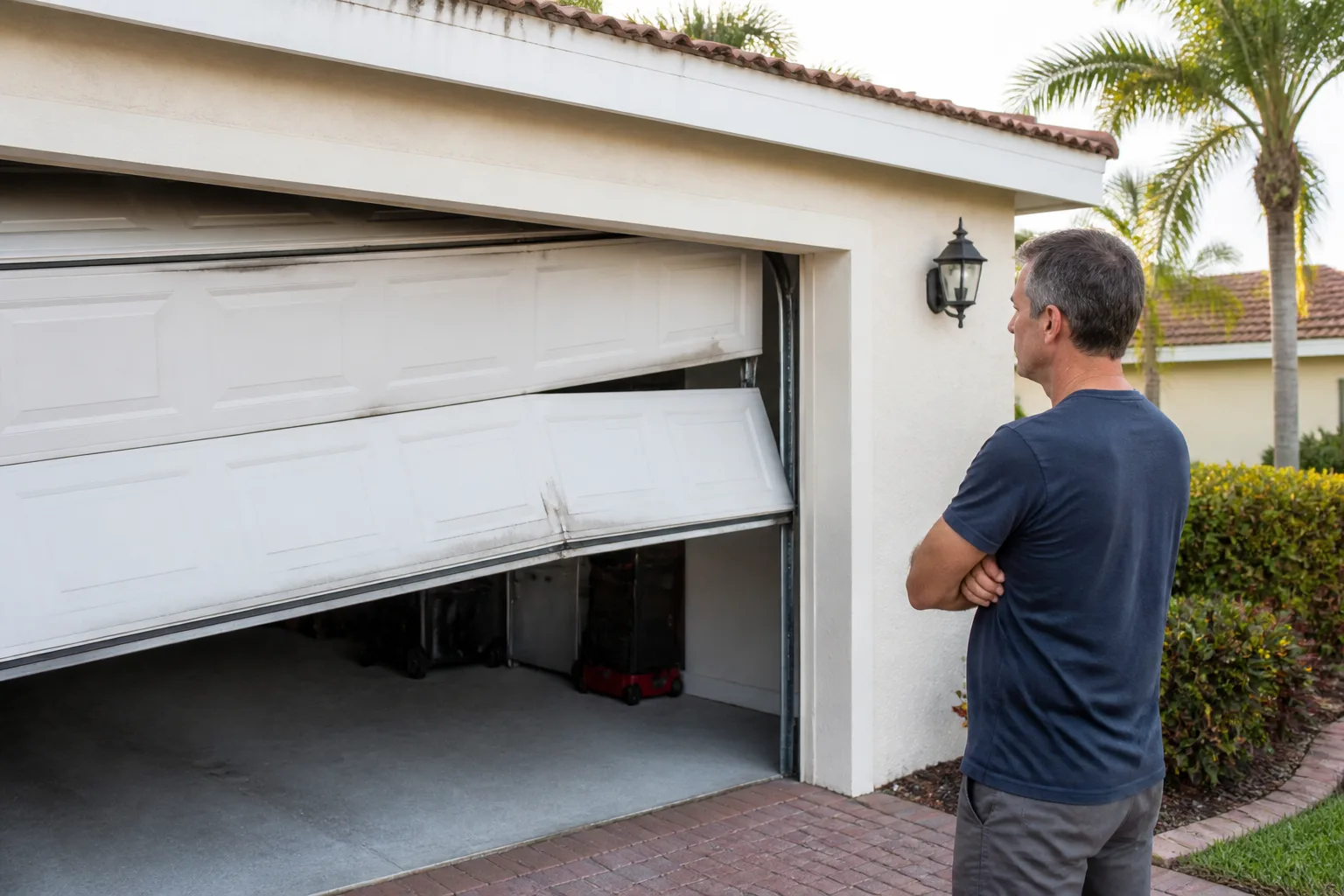
- Alignment. Stand back and look across the bottom edge. If one side sits higher than the other, or the door is cocked in the track, the springs or cables aren’t balanced.
A door that rattles, jams or refuses to move should be looked at by a trained technician. Cables and springs carry the full weight of the door and can snap without warning.
What does the manual balance test tell you about your springs?
The manual balance test tells you whether your springs are still holding the right tension, and it’s the single most useful 60-second check a homeowner can do. A balanced door should stay put wherever you leave it, halfway open. A door that slams shut from halfway needs spring help, not a new opener.
Here’s how to run it safely. Disconnect the opener first – most openers have a pull cord or release lever for exactly this – then lift the door by hand to about waist height and let go gently.
- Holds its position: the springs are still carrying their share of the load. Good news.
- Drifts down on its own: the springs have lost tension or one has broken. Expect heavy lifting and a struggling opener.
- Rises on its own or feels stiff to lift: the springs are over-tensioned, which is just as hard on the mechanism and just as unsafe.
If the door fails this test, stop there. Spring tension isn’t something to look up and adjust yourself – it’s the most dangerous repair in the garage, and it’s a core specialty for us for that reason. One of our technicians has up to 9 years of experience with torsion and extension systems, and that hands-on time matters when a door is heavy and the springs are the reason why.
Why “a little slower than it used to be” is a real warning sign
A door that’s noticeably slower than it used to be is showing you extra load on the system, and the cause is usually a loss of spring tension or a worn part that’s dragging. It’s not just aging. A door that labors now is one that will strain its motor, wear its rollers and eventually stop somewhere inconvenient.
Think about what the motor is actually doing. When the springs are doing their job, the opener only guides the door. When the springs weaken, the opener takes on the door’s full weight, every single cycle. That’s when we see opener gears strip, drive belts slip and boards fail on otherwise sound units – LiftMaster, Chamberlain, Genie and Craftsman included.
If the door moves slowly but steadily, a proper check of tension and hardware usually finds the cause. If the door moves unevenly, jerks, or reverses on its own, it needs a look before it gets worse. Either way, we work on your brand and know the quirks of each one, so a sluggish door gets diagnosed rather than guessed at.
What about Florida weather and your door’s hardware?
Florida’s humidity and heat put wear on a garage door faster than most homeowners expect. Wooden door sections absorb moisture and swell, rubber seals crack under the sun, and metal hardware near the coast picks up corrosion from salty air near Tampa Bay. That’s a lot to ask of one moving part of the house.
In Sun City Center specifically, that means a few things are worth looking at more often:
- Wooden and wood-composite doors – Clopay and similar wood-look panels can swell and stick in humid stretches. Sticking sections strain the opener and springs.
- Rubber bottom seals and weatherstripping – UV exposure hardens them until they crack. A cracked seal doesn’t just leak; it can trip the safety sensor on your Genie or LiftMaster unit.
- Hinges, rollers and metal tracks – humidity and salt air encourage corrosion. A rusty hinge drags, and a binding track is hard on everything else.
- Insulated panels – the foam core in insulated doors can take on moisture if an Amarr or Wayne Dalton panel is dinged and the skin is compromised.
The fix for most of this is simple: look at the door twice a year, keep the hardware clean and lightly greased, and call when something looks off. That’s the cheapest way to protect the door’s remaining service life.
When should you call a pro?
Call a pro the moment the problem involves a spring, a cable, or anything that leaves the door heavy, crooked or partly open. Those parts are under tension and can fail suddenly, and repairs there are genuinely dangerous to handle yourself. Everything else – worn seals, dry squeaks, a slow door – is safe to keep an eye on for a short while, but not for months.
The line we draw with homeowners is simple: if you can watch it from the floor, you can check it. If it means reaching into the mechanism, it’s a job for a trained technician. That’s what we’re here for.
Related services in Sun City Center
We handle garage door repair for worn hardware and alignment issues, garage door opener repair when the motor is straining or the electronics misbehave, and full replacement when a door has reached the end of its life. Start with a look at Sun City Center Garage Door Repair if you’d rather have us take a look. Emergency service is available when a door won’t move – we’re not a weekdays-only operation.
Key Takeaways
- A popping snap from above the door means a spring broke – stop using it.
- A steady squeak is usually lubrication; a grinding rumble usually means worn rollers.
- The manual balance test is the fastest way to check spring health.
- Slowing down is a load signal, not just aging.
- Florida humidity and sun wear out wood sections, seals and hardware faster than expected.
The Bottom Line
Every warning sign on this list has a cheap version and an expensive version. Catching a worn roller or a dry hinge early costs a fraction of what a spring failure does after the opener has been fighting it for months. If you’re in Sun City Center and need help, Sun City Center Garage Door Repair offers free estimates – call (855) 658-4128. We quote the price before any work starts, so the written estimate is the number you’ll see on the invoice.
Frequently Asked Questions
Grinding, squealing or popping sounds, a door that moves unevenly or reverses on its own, visible cable fraying, flat-spotted rollers and a gap under the bottom seal are the most common signs. Any of them is worth a look before it turns into a bigger repair. Call (855) 658-4128 for a free estimate.
A broken spring usually makes a loud snap, leaves the door very heavy, and fails the manual balance test – the door won’t hold position when lifted. Worn springs cause a slow, laboring door without a snap. Either way, don’t operate the door until it’s checked. Call us for spring repair and a straight answer on what it needs.
No. A slow door is showing extra load from weak springs or dragging hardware, and that load only increases over time. The sooner it’s checked, the cheaper the fix usually is. Call (855) 658-4128 to schedule an estimate.
We service Genie, Clopay, Amarr and Wayne Dalton, along with LiftMaster, Chamberlain, Craftsman and Raynor, and we work on garage doors exclusively. That single-trade focus means we diagnose by system knowledge rather than guesswork. Call (855) 658-4128 for a free estimate.
Written by the team at Sun City Center Garage Door Repair.
Need Garage Door Help?
Call Sun City Center Garage Door Repair - the local pro we connect you with is licensed and insured, here with fast after-hours help in Sun City Center.
(855) 658-4128